


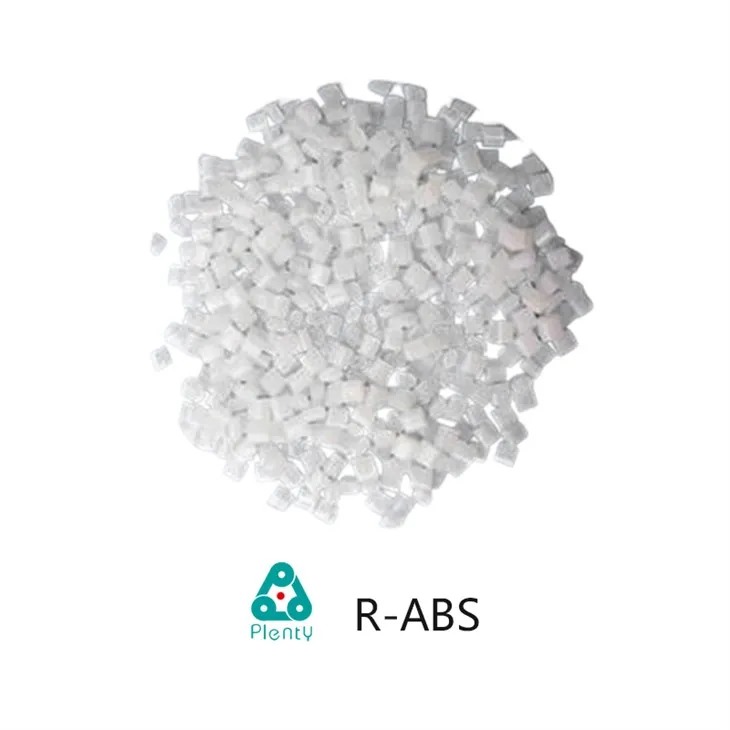


What is Reprocessed ABS Granules?
Reprocessed ABS Granules refer to granular thermoplastic materials producing by subjecting waste ABS products and production scraps to a series of physical recycling processes including crushing, cleaning, sorting, melt extrusion and pelletizing. These granules retain the basic molecular structure of ABS resin and can be reused for injection molding, extrusion, thermoforming and other molding processes.
It can be classified into multiple grades according to specific requirements, such as Eco-friendly reprocessed ABS granules, Colored Recycled ABS, Natural Recycled ABS, Transparent Recycled ABS, Modified Recycled ABS, Recycled ABS Flakes, Recycled ABS Pellets, Circular economy reprocessed ABS granules, Post-industrial reprocessed ABS granules.
Advantage and Disadvantage
Advantage
Reprocessed abs granules offer significant cost advantages, as they use waste ABS as raw material-with procurement costs far lower than virgin resin-and are typically priced 20%–50% cheaper, cutting downstream production costs for cost-sensitive mid-to-low-end applications.
Their strong environmental benefits reduce waste landfilling/ incineration, alleviate soil and water pollution, save petroleum-based resources, align with circular economy and carbon neutrality trends, and help enterprises meet environmental regulations and green certifications.
High-quality recycled pellets also feature processing performance close to virgin materials, boasting similar melt fluidity and moldability. They are compatible with conventional processes like injection molding, extrusion, and blister molding without major equipment parameter adjustments, while retaining decent impact resistance, rigidity, and low-temperature resistance to satisfy the needs of non-load-bearing parts (e.g., toys, luggage, daily necessities, electrical housings). they have notable drawbacks.
Disadvantage
Poor performance stability stems from complex raw material sources and thermal degradation during recycling, causing batch-to-batch fluctuations; impact and tensile strength are usually 10%–30% lower than virgin materials.
Appearance and purity defects include residual impurities (ink, pigments, metal debris, other plastics), leading to uneven color, surface spots, and poor finish-unsuitable for high-end applications like premium appliance casings or automotive interiors.
Additionally, recycling damages anti-aging additives, resulting in reduced weather resistance, UV resistance, heat resistance, and chemical resistance, with products prone to yellowing, cracking, and embrittlement under harsh conditions.
Finally, their application scope is limited, excluding high-demand fields such as medical devices, aerospace components, and food-contact products, and is confined to mid-to-low-end sectors.
Application

Hot Tags: reprocessed abs granules, China reprocessed abs granules manufacturers, suppliers, factory, Biodegradable TPV, flame retardant EPS granules, PLA Resin, Orange PET, Weather resistant AS particle, Purple PET


